What a Curtain Barcode Record Should Actually Tell You
A curtain with a barcode but no usable record is still a curtain nobody can account for.
October 27, 2026 · 3 min read
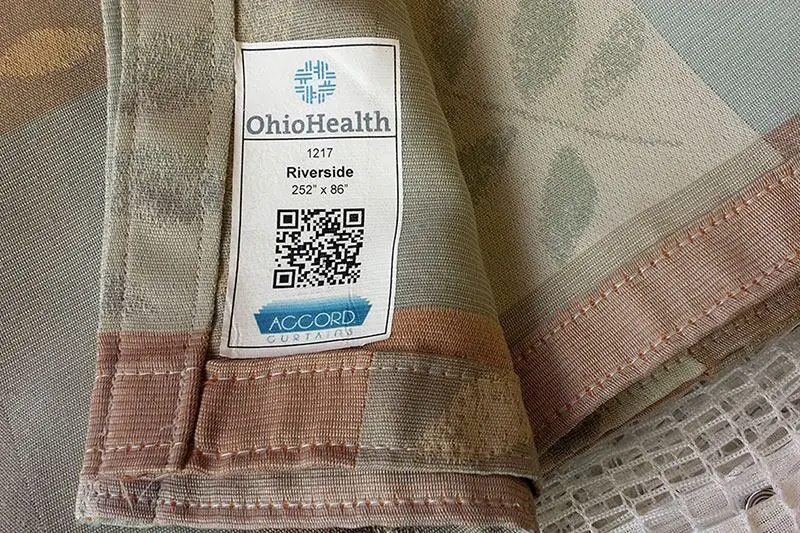
Ask a hospital how recently its curtains were cleaned and the honest answer is often a shrug. Nobody is being careless. There just isn't a record. The curtain in room 412, bed B went up at some point, and whatever has happened since lives in a person's memory or on a clipboard that moved to another floor.
A record that travels with the curtain
A good curtain record answers one question quickly: what has happened to this curtain, and when? Accord Curtains has been tracking curtains by QR code since 2011. A customer asked for barcoding that year, and Accord began logging the history of each individual curtain. In 2015 the company turned that habit into Accord Curtains Tracking Software, known as ACTS, which is cloud-based, so the record doesn't sit on one workstation in one office.
The label on the curtain itself carries the QR code. Accord's label photo shows one up close, with the facility name and a location code printed beside the code. A person with a scanner reads it, and the system takes it from there.
Four fields every scan should capture
If you're evaluating any tracking system, Accord's or someone else's, check what a single scan writes down. Accord's ACTS records these each time a curtain is taken down or re-hung.
- Date. The baseline fact, and the one an audit conversation starts with.
- Time. It separates a morning take-down from an evening re-hang and shows how long a bay stood uncovered or on a spare.
- Employee. Whoever did the work is named. That makes the record about accountability, not just inventory.
- Location, down to the room number. A record that says only the building can't tell you which of forty rooms on a floor it means.
Notice that each field answers a different follow-up question. Without the employee field you can't ask who. Without the time you can't ask how long. Without the room you can't ask where. A record missing any one of them gets awkward the first time someone from Infection Control pushes on it.
Reports that match how you think
Facilities don't think in curtains. They think in buildings, departments, floors, rooms and cubicles. ACTS reports in real time along those same lines: by building, department, floor, room and cubicle. A detailed report also goes out after each job, so there's a document in your inbox without anyone requesting it.
In practice, that means the questions you actually get asked have quick answers. Which rooms on the fifth floor haven't been serviced this quarter? How many curtains came down in the emergency department last month? Who rehung the curtains in room 218, and at what time? Those are everyday questions, and answering them from a report beats walking the unit to look at labels.
Labels need to survive
A barcode helps only while it still reads. A curtain label gets handled, folded, bagged and carried between a hospital and a laundry, then hung back at ceiling height where nobody looks at it. Whatever system you choose, ask how the label holds up through repeated cleaning, where it sits on the curtain so a scanner can reach it from the floor or a ladder step, and what the process is when one becomes unreadable.
Ask about the opposite case too: a curtain that arrives with no label at all. At Accord, the fifth step of the process is barcode-labeling every curtain with ACTS, so an unlabeled curtain doesn't stay that way for long.
What the record does not do
A curtain record is evidence of what was done and when. It doesn't prove a clinical outcome, and it shouldn't be presented as if it does. What it does is take away the guesswork. When an Infection Control committee asks whether a given unit is on schedule, the answer is on a screen, with names and times attached.
To see what a barcoded inventory would look like for your building, call Accord Curtains at (614) 340-9900 or email info@accordcurtains.com to book a curtain inventory.
Accord Curtains, (614) 340-9900
Call (614) 340-9900More articles
How Often Should Hospital Privacy Curtains Be Cleaned?
One schedule for the whole building is easy to write and usually wrong, so start from how each unit actually uses its curtains.
What Happens to the Curtains When an Isolation Room Is Discharged?
The patient leaves, the room gets reset, and the cubicle curtain is the one item that waits for someone with a ladder.